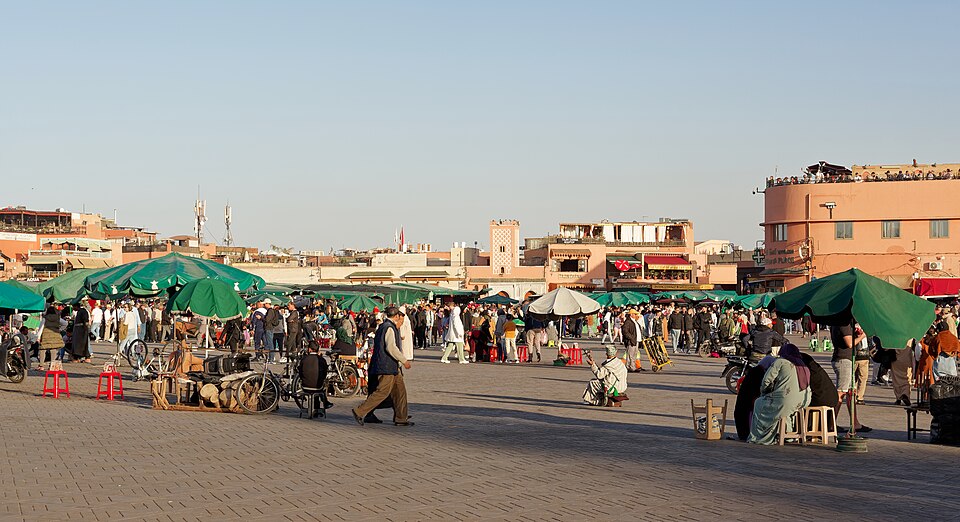

Marrakech is Morocco's most visited city, and it is easy to see why: a UNESCO-listed medina, palaces with carved cedar ceilings, colourful gardens and a main square, Jemaa el-Fna, that hardly ever sleeps. Here are the must-sees, grouped by area to save time, plus a plan for two or three days.
The must-sees at a glance
| Place | Area | Time to allow | Why go |
|---|---|---|---|
| Jemaa el-Fna square | Heart of the medina | 1 to 2 h, ideally late afternoon | Storytellers, musicians, food stalls: the soul of the city |
| The souks | North of Jemaa el-Fna | 2 to 3 h | Crafts, spices, leather, lanterns |
| Koutoubia minaret | West of Jemaa el-Fna | 30 min | The city's landmark |
| Ben Youssef Madrasa | North of the medina | 45 min to 1 h | Former Koranic school, zellige tiles and carved stucco |
| Bahia Palace | South of the medina (kasbah) | 1 h | 19th-century palace, painted ceilings, courtyards |
| El Badi Palace | Kasbah | 1 h | Vast ruins of a Saadian palace |
| Saadian Tombs | Kasbah | 30 to 45 min | Richly decorated mausoleums, rediscovered in 1917 |
| Majorelle Garden and Yves Saint Laurent Museum | Gueliz (new town) | 1 h 30 to 2 h | The famous Majorelle blue and YSL fashion |
| Le Jardin Secret | Medina (Mouassine) | 45 min | A quiet restored garden right in the centre |
| Menara Gardens | West of the city | 45 min | Large pool and olive grove facing the Atlas |
Times are approximate. Opening hours and entry fees change regularly: check them on site or on the official websites before you go.
The medina, Jemaa el-Fna and the souks
Jemaa el-Fna square
This is where every visit starts. The square is fairly quiet in the morning, livens up in the afternoon and is transformed at sunset by grill stalls, Gnawa musicians and storytellers. Its "cultural space" was proclaimed a Masterpiece of the Oral and Intangible Heritage of Humanity by UNESCO in 2001, then inscribed on the Representative List in 2008. For the big picture, head up to one of the café terraces around the square.
The souks
North of the square begins a maze of market lanes: spices, babouches, rugs, pottery, pierced-metal lanterns, leather goods. Craftsmen are often grouped by trade, such as the dyers or the coppersmiths. Getting lost is easy, and that is half the fun: keep a landmark in mind (the square or the Ben Youssef Madrasa) and an offline map app on your phone.
A World Heritage medina
Founded in the 11th century by the Almoravids, the medina of Marrakech has been a UNESCO World Heritage Site since 1985, together with its ochre earth ramparts, monumental gates and the Menara and Agdal gardens. A walk along the walls or through the Bab Agnaou gate in the kasbah rounds off the visit nicely.
Palaces and monuments
The Koutoubia
About 77 metres high according to UNESCO, the 12th-century Koutoubia minaret towers over the medina and is visible from almost everywhere. As in most Moroccan mosques, the prayer hall is reserved for Muslims: admire the minaret from the esplanade and the neighbouring gardens, which are lovely in the late afternoon.
Ben Youssef Madrasa
This former Koranic school, built in the 16th century under the Saadian dynasty, is one of the finest examples of the city's architecture: a central courtyard with a pool, zellige tiles, carved stucco and cedar wood. It was restored following works launched in 2017. Upstairs you can see the students' tiny rooms.
Bahia Palace
Begun in the 1860s by grand vizier Si Moussa and enlarged until 1900 by his son Ba Ahmed, Bahia Palace ("the beautiful") is a succession of courtyards, inner gardens and rooms with painted ceilings. It gets busy: arrive at opening time to enjoy the patios in peace.
El Badi Palace and the Saadian Tombs
El Badi Palace was begun in 1578 by the Saadian sultan Ahmad al-Mansur; only huge walls, sunken pools and storks' nests remain, but the scale is still impressive. A few minutes' walk away, the Saadian Tombs hold the burials of that dynasty; long forgotten, they were rediscovered in 1917. The main hall, with its marble columns, often has a queue.
Gardens
Majorelle Garden and the Yves Saint Laurent Museum
Created from 1923 by the painter Jacques Majorelle, this garden of cacti, bamboo and pools, with its vivid blue villa, was bought in 1980 by Yves Saint Laurent and Pierre Bergé to save it from a property development. The Yves Saint Laurent Museum, opened in 2017, is on the same street. It is one of the city's most visited sights: buy your tickets in advance on the official website and aim for an early slot.
Le Jardin Secret
In the heart of the medina, in the Mouassine quarter, this restored garden opened to the public in 2016 combines a classic Islamic garden and an exotic garden. Its tower offers a nice view over the rooftops. It is the perfect break between two souks.
The Menara and the Palm Grove
The Menara Gardens, with their large pool and pavilion facing the Atlas, are at their best on a clear day. The Palm Grove (Palmeraie), north of the city, is best explored by camel, quad bike or horse-drawn carriage.
Experiences worth booking
- A hammam: a traditional neighbourhood one for local atmosphere, or a riad spa for more comfort.
- A cooking class: tagine, couscous or pastries, often starting with a market visit.
- A guided medina tour: a licensed guide keeps you from getting lost and brings the history to life.
- A hot-air balloon flight at sunrise over the villages and palm groves (weather permitting).
- An evening in the Agafay desert, less than an hour's drive away: see our day trips from Marrakech.
A 2 or 3-day plan
- Day 1 – Northern medina: Ben Youssef Madrasa in the morning, the souks, lunch, Le Jardin Secret, then Jemaa el-Fna at sunset.
- Day 2 – Kasbah and new town: Bahia Palace at opening time, El Badi Palace, the Saadian Tombs, then Majorelle Garden and the YSL Museum in the late afternoon (booked slot), and the Koutoubia on the way back.
- Day 3 – Out of town: a trip to the Ourika valley, Imlil or Essaouira, or an evening in Agafay (see our day-trip guide).
Practical tips
- When to go: spring and autumn are the most pleasant; summer is very hot, so sightsee early in the morning and in the evening.
- Petits taxis: ask for the meter to be switched on or agree the fare before getting in.
- Touts: in the medina, politely decline improvised "guides" offering to show you the way; book a licensed guide in advance instead.
- Haggling: it is part of the game in the souks; keep smiling and set yourself a maximum price.
- Dress: clothes covering shoulders and knees are appreciated in the medina.
- Getting there: Marrakech has an international airport; driving from Europe, see our guide to ferries to Morocco.
Frequently asked questions
How many days do you need in Marrakech?
Two full days are enough for the medina highlights and Majorelle Garden. With three or four days, add a trip to the Atlas, Essaouira or the Agafay desert.
Can you visit the Koutoubia mosque?
The interior is reserved for Muslims, as in most mosques in Morocco. You can, however, admire the minaret and stroll in the surrounding gardens.
Do you need to book Majorelle Garden?
It is strongly recommended, especially in high season: tickets are sold online on the official website by time slot.
What to do in Marrakech at night?
Have dinner on Jemaa el-Fna or on a terrace overlooking it, catch a show, or head out for an evening in the Agafay desert with dinner in a tent.
This article is for guidance only: opening hours, prices and visiting conditions change. Always check with the official websites or providers before you go.